
Sit through three agency pitches in a row and they start to blur. Everyone knows manufacturing. Everyone has a proven process. Everyone shows you a dashboard. I spent 23 years running a manufacturing company before I started doing this work, and the pitches sound alike because the pitch is the easy part. The interview is where you find out who is real. This article covers one piece of a bigger decision; the full evaluation lives in How to Choose a Manufacturing Lead Generation Company, and for the wider subject, see Manufacturing Lead Generation.
Two questions separate an agency with a real methodology from one that is guessing: How do you know what to write about? And do you have technical people or engineers as part of your writing process? Ask those two, then ask for measured results with a client's name, a date, and a measurement method attached. An agency that can answer all three has a system you can inspect. An agency that answers with adjectives has a pitch.
What questions should I ask a manufacturing marketing agency?
Ask three things: how they decide what to write about, whether technical people are part of their writing process, and what measured results they can show for a named manufacturing client, with the date and the method attached. Those three questions tell you more than any capabilities deck.
The first question matters because most content written for manufacturers is written about the product, when the content an engineer actually uses is written about the customer's problems. An agency with no way of knowing what buyers actually ask is guessing at topics, and guessed topics produce articles nobody was searching for. Our own answer: we use a proprietary research process that validates actual search demand rather than estimating it. I won't say what the technology is, because that is our advantage. But that is the level of answer to expect from anyone. Not "we do keyword research," but a specific way of knowing that real buyers are asking the question before anyone writes a word.
The second question matters because of who has to trust the result. Engineers rate engineering experts at vendor companies as the most trustworthy authors of technical content, at 66% very or extremely trustworthy, while generative AI tools rank last at 10% (GlobalSpec, 2026 State of Marketing to Engineers, p.33). The right answer is not that engineers write the articles. It is that technical people are in the process: the writer interviews your expert, drafts, and the expert reviews and corrects before anything publishes. If there is no technical review step, the content will read that way to the one audience that counts.
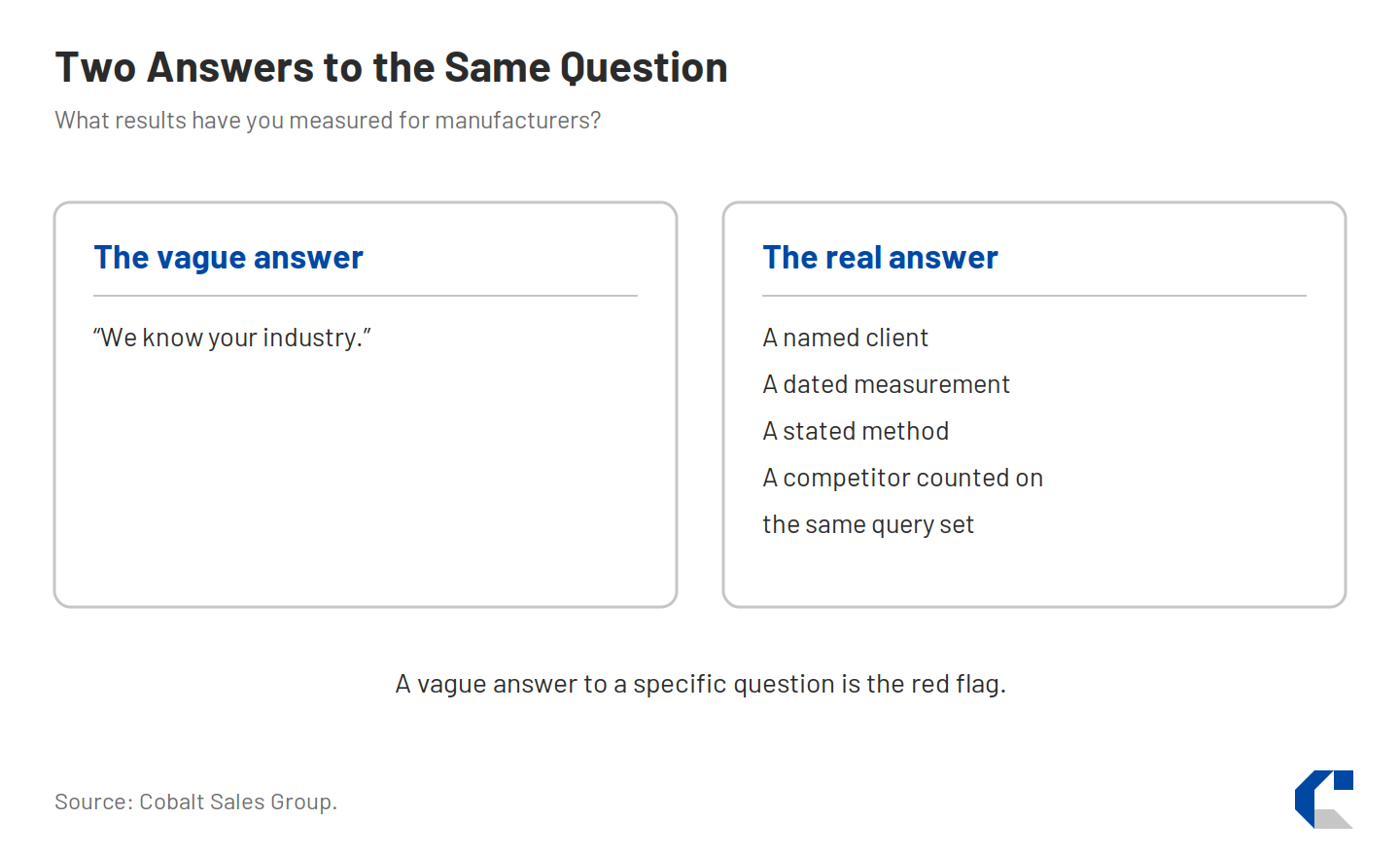
Then ask for results, and hold them to a standard: a name, a date, and a denominator. Here is what that looks like. Pulse Drying Systems' spray dryers content holds a 40.7% citation rate in Google AI Overviews, 458 of 1,125 tracked queries at the August 2, 2026 scan, against competitor GEA at 10.6% of the same 1,125 queries. Dataprobe's managed power distribution content sits at 25.3%, 230 of 910 tracked queries at the same scan. Both clients approved being named. Whether the numbers are ours or someone else's, that is the shape of a real answer. "We tripled their leads" with none of those attached is not a case study; it is a claim.
 Source: Cobalt Sales Group.
Every warning sign in this interview is the same thing: a vague answer to a specific question. The patterns behind the failures deserve their own discussion, and they get it in Why Lead Generation Companies Fail for Manufacturers.
What is the difference between a marketing agency and a lead generation company?
A marketing agency builds your visibility and authority over time; a lead generation company delivers contact names now. The difference is not quality. It is what you are buying, and what each business is paid to produce.
That payment structure shapes behavior. A firm paid per lead is paid for volume. That is not dishonest, it is the business model, and I offer it as reasoning about incentives, not as a dataset. A firm on retainer for authority work is paid to make you the company buyers find and trust when they research the problem you solve. The approach we use, Pillar-Based Marketing, is that second kind: structured content built around questions buyers are verifiably asking, deep enough that search engines and AI systems treat your company as the authority on the subject. That is also how this kind of work reaches technical decision-makers. Not by interrupting them, but by being the source they find when they go looking.
The two are measured differently as well. Lead generation companies report lead counts; authority work reports visibility. Which fits you depends on what you sell. When US executives describe their final RFP decisions, expertise ranks first at 85% and "the safest choice" ranks last at 41% (Edelman-LinkedIn, 2025 B2B Thought Leadership Impact Report, p.22). Those are self-reported preferences from a US-only survey, but the signal is consistent: technically differentiated sellers win on demonstrated expertise, which is what authority work builds and lead volume does not.
If you want to see how your company compares with the competitors buyers find, start with the Buyer Visibility Audit.
Are lead generation companies worth it
They can be, for transactional or commodity sales where volume matters and one qualified buyer looks much like another. For a manufacturer with technical differentiation and a long sales cycle, they usually are not, and the questions above will tell you which situation you are in.
Here is the test I give owners: most of my clients are not looking for volume. For a niche manufacturer, two or three good new customers a year justifies the whole effort. If that describes you, a stack of contact names solves a problem you do not have. Ask the company how it qualifies technical fit, meaning whether the people on its lists have the application, the specifications, and the timeline that make them worth your quoting time. In my experience, lead counts without technical qualification produce busy salespeople rather than customers. I cannot hand you a dataset on that; it is what I have watched happen. It is also exactly what the qualification question is designed to surface before you sign anything.
Can I do lead generation in house or should I outsource it?
Put the same two questions to your own team. If you can answer them internally, with a reliable way of knowing what buyers actually search for and technical review of everything you publish, you can do this in house. Most manufacturers I talk to have the second and not the first.
Your in-house advantage is real: the technical experts already work for you, and no agency can replicate that. What is usually missing is the demand research, knowing which questions are being asked rather than which ones you assume are, and the discipline to publish consistently when everyone has a day job. So the practical answer is often a hybrid. Your experts supply the knowledge and the review; an outside process supplies the research, the writing, and the cadence. Whichever way you go, the standard does not change. An internal program that cannot say how it knows what to write about has the same problem as an agency that cannot.
The Interview Runs Both Ways
One last thing to watch for: a good agency will interview you. Expect questions about your customers, what makes your work different, how inquiries reach you, and whether you can respond quickly when they do. An agency that only pitches and never asks is telling you how the relationship will run. These questions are not a trap for salespeople. They are how you find the firms that have actually done this work for manufacturers, and how you find out, before any money moves, whether you are talking to one.
Frequently Asked Questions
How do agencies typically measure success when it comes to generating qualified leads in the manufacturing industry?
The honest ones measure what they can actually see. In our case that is three things: AI citation rate in Google AI Overviews, search rankings, and organic traffic. Inquiries and RFQs land in your phone system, your inbox, and your CRM, places an outside firm does not sit, so when a client tells us inquiries are up, we treat that as a real signal and an anecdotal one, and we say so plainly. Be cautious with any agency that reports precise lead-quality figures from systems it never touches; ask where the number comes from before you rely on it.
Editorial Note
I source from primary research where I can reach it, credible reporting of it where I can't, and leave out what I can't verify at all. Cobalt's own client figures include the measurement method and sample size.
The recommendations reflect my experience, not a settled answer. Search and buyer behavior keep changing, your situation isn't identical to my clients', and I still get things wrong. Verify anything that matters.
If you are interviewing agencies right now, use these questions on us too. I will show you our numbers with the client named, the date attached, and the method explained, and I will tell you plainly what we do not measure. If our answers don't hold up to the standard I just handed you, you'll know what to do.
If you are interviewing agencies right now, use these questions on us too. I will show you our numbers with the client named, the date attached, and the method explained, and I will tell you plainly what we do not measure. If our answers don't hold up to the standard I just handed you, you'll know what to do.
Book a Discovery Meeting