
Most owners come to this decision the same way. Referrals slowed down. The two people who used to send you work retired or moved. Somebody at a trade association mentioned they hired a marketing firm, so you start looking, and within a week you have six proposals on your desk.
They all sound alike. Every one of them promises qualified leads. Every one has case studies from industries that are not yours. Two of them use the same stock photo of a robotic arm. You are supposed to pick the best one, and you have no way to tell them apart, because nobody has explained what you are actually buying.
That is the real problem here, and it is worth solving before you take another meeting. For the full picture, see Manufacturing Lead Generation.
Companies sell two different things under the same name. One kind captures demand that already exists, by making sure you show up when a buyer goes looking for what you make. The other kind creates interruptions and hopes to catch somebody at a moment when they happen to care. Those two businesses need different amounts of money, run on different timelines, and define a good lead in incompatible ways. A firm that is excellent at one will look like a bad investment if you were expecting the other.
So before you compare providers, settle three things for yourself: what a lead has to look like before you would be glad to quote it, whether you are buying volume or authority, and who is responsible for the prospect once the inquiry lands in your inbox. This article covers what you are buying and how the pieces fit together. Pricing models, the specific questions to ask in the meeting, and the ways these engagements go wrong are each worth their own treatment.
Should I hire a lead generation company for my manufacturing business?
Hire a lead generation company when buyers are researching what you make and not finding you, and when you can commit both money and time for at least two years. Those two conditions travel together. The first one is common. The second one is where most engagements come apart, because manufacturers routinely sign up expecting leads in ninety days, and that is not how this works for a product with a long sales cycle.
I will say the part nobody selling this says out loud. Lead generation is hard, and it is getting harder. If you are not willing to make the investment in both money and time, you are probably better off not spending anything on it and just hoping for referrals. That is a real option. It is a worse option than it was ten years ago, but it beats spending eighteen months of budget on something you abandon at month seven.
The reason the time horizon matters so much is that the two approaches leave behind different things. Outbound spending stops working the day you stop paying for it. Content and search visibility compound. You publish something that answers a question buyers are actually asking, it earns its position, and it keeps earning while you sleep. Compare that to a salesperson: you hire, you spend a year or two getting them up to speed, and if they quit you start over with nothing to show for it. Both are investments. Only one of them accumulates.
Search top lead generation companies and you will get lists assembled by people paid to assemble lists. They are useful for names and almost nothing else, because the ranking criteria are usually undisclosed and the firms on them serve every industry at once. Judge a firm on whether they can show you work in a technical field, and on whether the person writing about your process has any idea what your process is.
There is evidence for what actually decides these things at the end. In Edelman and LinkedIn's 2025 B2B Thought Leadership Impact Report, executives ranked what mattered in a final RFP decision: demonstrated expertise came first at 85 percent, understanding of the buyer's challenges at 76 percent, strategic fit at 74 percent. Being the safest, most familiar choice came last at 41 percent. Those are stated preferences from a survey of 1,934 US executives rather than measured behavior, so treat them as what buyers say they weigh. Still, the ordering is worth sitting with. The thing you can build is expertise on the record. The thing you probably cannot outspend is somebody else's brand recognition.
Can you do this in house instead? Partly. The work splits into three pieces: finding out what buyers are actually searching for, producing content that answers it at a technical level, and publishing consistently for years. Most manufacturers have the second piece sitting in their engineering department and cannot free up the time to use it. Almost nobody has the first, because guessing at topics is not the same as measuring demand, and the difference does not show up until a year of work has gone nowhere.
The hybrid version is the one I see work most often. The manufacturer supplies the expertise and the review, an outside team handles the research, the writing, and the publishing rhythm. Your engineers should not be writing articles. They should be answering questions and correcting drafts, which takes a fraction of the time and is the part only they can do.
What is the difference between inbound and outbound lead generation?
Inbound captures demand that already exists. Outbound creates an interruption and hopes to land it at the right moment. With inbound, a buyer with a problem goes looking, finds your answer, and arrives already partway convinced. With outbound, you pick the list, you pick the timing, and you are almost always early or late. The distinction between outbound leads vs inbound leads is really a distinction about who started the conversation, and that governs everything downstream, including how many of those leads are worth quoting.
It would be easy to read this as "buyers do not want to talk to salespeople." That is not what the research says. GlobalSpec's 2026 State of Marketing to Engineers found that only 10 percent of technical buyers would prefer not to interact with a salesperson at all. What they are doing is delaying the conversation, not avoiding it. The same survey found that when they finally do reach out, the top trigger is a pricing or inventory question at 26 percent, followed by validating something they found online at 23 percent, and technical complexity at 21 percent. By the time your phone rings, they have done the reading. They are checking their work.
That is the case for inbound, and it is a strong one for anything with a real specification behind it. It is not a case against outbound everywhere. I have a client who sells replacement filters that fit other manufacturers' equipment. They run paid campaigns against competitor part numbers, and it works, because the item is inexpensive, the volume is high, and somebody typing that part number has already made the decision. Low cost and high volume is where paid earns its money. Long cycles and engineered products are where it usually does not.
A pay per lead agency sells you the output instead of the work. You pay per name delivered, which sounds like a way to move the risk onto them, and in one narrow sense it is. The catch is what it does to incentives. When the fee is per lead, volume is the product, and volume and fit pull against each other. That model fits businesses selling something transactional at scale. It is a poor fit for a shop quoting six-figure tooling packages. The moment a single new customer is worth more to you across five years than a hundred names are worth today, you are buying the wrong thing, and that is the honest signal that you have outgrown the model.
Directories sit somewhere in the middle. Thomasnet has produced good work for some of my clients and disappointed others on lead quality, and I have never found a reliable way to predict which. It is a real channel with real expectations attached to it.
Be careful with anyone selling you a single channel as the answer. McKinsey's 2026 Global B2B Pulse Survey of nearly 4,000 decision-makers across 13 countries found buyers now use an average of ten channels across a purchase, roughly double the number a decade ago. A provider who only does one of those ten is selling you a slice and calling it the meal.
What is considered a qualified lead?
A qualified lead is one you would be glad to quote. That sounds circular until you try to write it down, and most owners have never written it down. Technical fit with what you actually run, a real project rather than a price survey, somebody involved who can sign, a timeline you can hit, and a budget in the neighborhood of what the work costs. Miss any one of those and you have an inquiry, not a lead, and your estimator will spend two days proving it.
Here is why this has to be settled before you hire anyone: if you do not define qualified, the provider defines it for you, and their definition will be whatever their reporting makes look good. That is not dishonesty. It is what happens when nobody wrote the standard down.
The other thing worth saying to a manufacturer is that the number is allowed to be small. We are not looking for volume. It is great to be a niche company and dominate that niche. For most of my clients, two or three good new customers in a year is worth the entire program, and a report showing four hundred contact form fills would be a worse outcome. If a provider treats a low lead count as a problem to be fixed rather than a filter that is working, you are not looking at the same business.
What does lead nurturing mean?
Manufacturing lead nurturing means staying visible and useful to a buyer during the months or years between the first time they notice you and the day they have a project. In this industry, that gap is the normal case. Somebody is not changing their aluminum casting vendor often. What you want is to be on the short list, already credible, on the day the current arrangement stops working.
Most of the people you are nurturing will never identify themselves. In the Edelman and LinkedIn research, 71 percent of the hidden buyers surveyed reported little or no interaction with sales representatives. Again, self-reported, so read it as what they say about themselves. It squares with what I see. A great deal of the audience for good technical content is people who will never fill out a form, never take a call, and will eventually show up already knowing who you are.
This is also where the question of who writes the material stops being cosmetic. The same GlobalSpec survey asked technical buyers who they trust as an author. Engineering experts at vendor companies came first at 66 percent rated very or extremely trustworthy. Content produced by generative AI tools came last at 10 percent.
What that means in practice is not that your engineers should be writing articles. It means your engineers have to be in the process, answering the questions and correcting what comes back, and their names have to be on it. A firm that never asks to speak to your technical people is going to produce something about your product instead of something about your customer's problem, and an engineer can tell the difference in one paragraph.
One boundary matters more than anything else on this page, and almost nobody raises it in a sales meeting. A visibility program ends at the inquiry. We generate the content and execute the strategy to increase visibility. We do not have access to how quickly a client replies to a contact form, and we do not have visibility into their phone system, their inbox, or their CRM. That means a real part of what determines whether any of this pays off is not something an outside firm can do for you, or be measured on. Ask any provider where their responsibility stops. If the answer is vague, that vagueness will become a disagreement later.
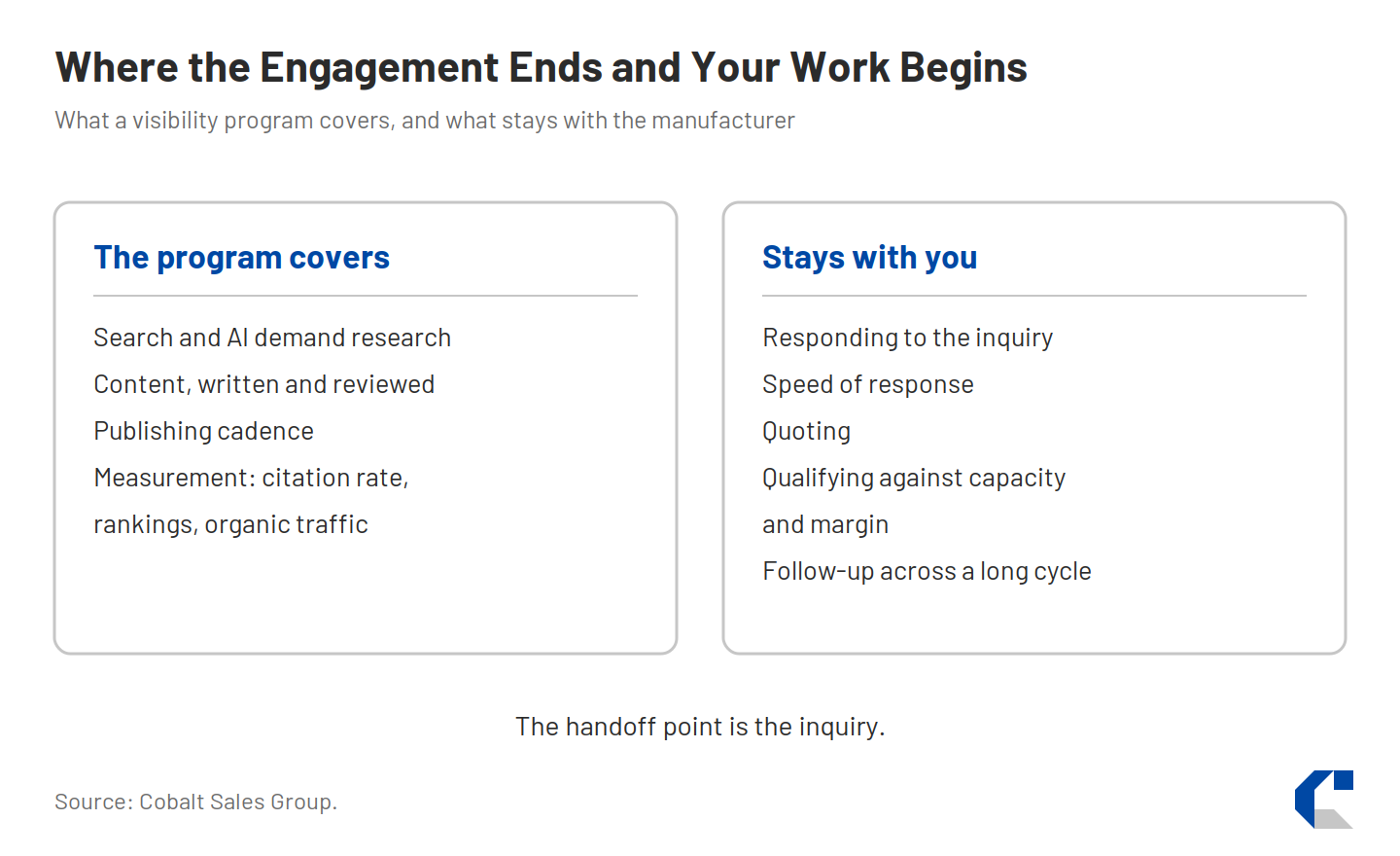 Source: Cobalt Sales Group." Place in the "What does lead nurturing mean?
What the client side of that line looks like in practice is worth two concrete examples. ACT Sensors runs a configurator that lets a buyer specify what they need and see pricing without talking to anyone. Most of their orders still arrive by phone or email, which is the point: the configurator answers the price question early so the buyer is willing to make contact at all. Dataprobe's main goal is free trial requests, and they report those going up since their content started ranking. That last one is a real signal and an anecdotal one. We do not measure it, they do, and I am telling you what they told me.
The failure mode here is usually operational rather than editorial. McKinsey's 2026 survey found that 52 percent of buyers would stop working with a supplier whose teams gave inconsistent information about price, availability, or lead time, making it the top switching driver that year. No amount of content survives a quote desk that says something different from the website.
What should you settle before you take the meeting?
You will not choose well between providers until you have decided what you want from one. Three things, in this order. What does a lead have to look like before you would be glad to quote it. Are you buying volume that arrives now or authority that accumulates, knowing that the second one asks for two years before it is fair to judge. And who owns the prospect the moment they raise their hand, because that is you, and no engagement changes it.
Answer those and the six proposals on your desk stop looking alike. Most of them will be selling something you have just decided you do not want, which is a much easier conversation than trying to work out which one is best.
The question that follows this one is what to actually ask in the meeting, and the answer is narrower than most owners expect. Two questions do most of the work: how do you know what to write about, and do you have technical people involved in producing the content. Guessing and measuring look identical in a pitch deck and nowhere else.
Frequently asked questions
What are 5 important factors to consider for a qualified lead?
Technical fit with what you actually run, a defined project rather than a price survey, a decision-maker involved somewhere in the conversation, a timeline you can meet, and a budget in range of what the work costs. Score an inquiry against those five before it reaches your estimator. The specific thresholds are yours to set, and setting them in writing is what stops a provider from setting them for you.
What is the difference between lead qualification and lead nurturing?
Qualification decides whether a prospect is worth your time right now. Nurturing keeps you credible with the ones who are not ready yet. They run on different clocks. Qualification is a decision you make in a few minutes with a checklist. Nurturing is a position you hold for months or years, usually with people who never tell you they are watching.
What is an example of lead nurturing?
ACT Sensors' configurator is one. A buyer can specify what they need and see pricing without contacting anyone, which answers the question that would otherwise stall them. Most orders still come in by phone or email afterward. That is nurturing in the industrial version: removing a reason to stop, well before anyone is ready to buy, and being the company that already answered the question when they are.
What is lead nurturing vs lead generation?
Lead generation brings new people into contact with your company. Lead nurturing keeps you in the running with people who are already aware of you but have no project yet. Manufacturers with long cycles usually need more nurturing than they think and less generation, because the constraint is rarely how many companies know you exist. It is whether they still remember you when the need finally arrives.
Editorial Note
I source from primary research where I can reach it, credible reporting of it where I can't, and leave out what I can't verify at all. Cobalt's own client figures include the measurement method and sample size.
The recommendations reflect my experience, not a settled answer. Search and buyer behavior keep changing, your situation isn't identical to my clients', and I still get things wrong. Verify anything that matters.
Ready to stop reading and find out where you stand?
Everything in the Learning Center explains the problem. The Buyer Visibility Audit™ tells you where your company sits right now — in Google, in AI answers, and against the competitors your buyers are comparing you to.
Request Your Free Buyer Visibility Audit →Free. No sales pitch. Delivered within 1–2 business days.