
Your website looks professional, it has been live for years, and maybe you have paid someone to improve it for the last two. The traffic report may even go up every month. And yet nothing about the business has changed. This article is a diagnostic for that situation, and a starting point for the larger subject covered in How Modern Manufacturers Get Found. The short version: most manufacturing sites describe the company instead of answering the questions buyers research, which leaves a search engine nothing to rank and an AI system nothing to cite. But there are several distinct causes, and one of them is not a website problem at all.
Why isn't my manufacturing website generating anything?
Why manufacturing websites don't rank usually comes down to one thing: the site describes the company rather than answering the questions its buyers are researching. A search engine has nothing to rank it for, and an AI system has nothing to cite.
If you are asking why isn't my manufacturing website getting leads, or why is my industrial website not generating leads, start there. Buyers do most of their homework before they contact anyone. GlobalSpec's 2026 State of Marketing to Engineers found that technical buyers complete 62% of the buying process online before speaking to someone at a vendor. A site that doesn't show up during that stretch is usually not in the running by the time the call gets made.
That is the most common cause, not the only one. Three others are worth ruling in or out: agency work aimed at the wrong target, a competitor that has simply published more than you have, and a market where demand itself has thinned. Each has a different fix, and the last one has no fix that marketing can provide.
Here is the encouraging part. When I run audits, owners are rarely surprised by what I find. Their competitors are usually the ones showing up, and they generally know they have been ignoring this. It is a known problem that got set aside, not a hidden one, and known problems are the easier kind to fix.
Is the problem the content, or the website itself?
If you are wondering why are we not ranking for our products, the answer is usually the content, not the website. Most manufacturing sites are online brochures: a company overview, a capabilities page, a product catalog. A catalog is not content, and a capability statement is not evidence of expertise.
Almost every manufacturer I have audited has a site that works this way. The online brochure has been around since the beginning of the internet and has barely changed. What buyers want from a website has changed completely. They are looking for educational material they can use to make a purchase decision: how a process works, what it suits, where the trade-offs are, what to send for a quote. That information is usually not on the site. What is there instead tends to be superlatives such as "highest quality" and "best in the country," claims most competitors also make and no buyer can check.
This fails on both surfaces at once. A product page listing part numbers and a line about quality answers very few of the questions a buyer types into a search box. And Google's documentation on AI features and your website says there are no additional requirements or special optimizations needed to appear in its AI Overviews beyond the fundamentals that apply to search generally. A site with little worth ranking usually has little worth citing either.
There is a second version of this problem: plenty of content, but no structure. Keats Manufacturing had been publishing for about ten years before we built its four-slide stamping pillar, and its visibility still rose considerably once the content was focused on one subject and organized. Volume alone does not make a site findable. Getting what your people already know onto the site, in a form buyers can use, is the subject of Proving Technical Expertise Online.
Why doesn't SEO seem to work for manufacturers?
Why doesn't SEO work for manufacturers? Often it does work, just on the wrong target. Generic SEO tends to chase search volume, and in manufacturing the high-volume terms often bring visitors who were never going to buy.
A broad term like "metal stamping" is searched by students, job seekers and people curious about the industry, alongside the occasional buyer. Rank for terms like that and traffic rises. If your traffic report climbs every month and nothing has changed at the front desk, this is a likely reason. The buyer who matters searches narrower: an application, a material and a tolerance, a problem he is trying to solve. Those searches are smaller and far more valuable, and finding them takes someone who understands the product.
That is usually an industry-knowledge gap, not incompetence. An agency that cannot brief a technical article, or tell a good one from a bad one, will struggle to build authority for a manufacturer however capable it is at the mechanics. It is also the most common answer to why am I paying for SEO with no leads: the work may be real, but it is aimed at an audience that does not buy.
I have been on the receiving end of this. More than twenty years ago I hired an SEO company for my telecom remanufacturing business. They said they could get us to the top of search when people looked for what we sold. We didn't show up for anything, and to this day I couldn't tell you what they actually did. They also transferred our domain into their own name, which is what bad operators do, and a good reason to confirm today that your company owns its domain. Many owners are in a milder version of that position now. They get reports, often good ones, but the reports rarely show whether the content is reaching the buyers who matter.
Why does a competitor keep showing up above us?
Why are competitors showing up above us on Google? In most cases the competitor has published more substance on the subject than you have, and its name also appears on sites it doesn't own. On Google that shows up as ranking; in AI answers it shows up as being named.
Size is usually not the variable. Comparing a company with a brochure site against one with buyer-focused educational content, I can almost always predict that the one with the content will be out-ranking, and out-AIing, the other, regardless of which is bigger. The competitor ahead of you is also rarely doing this well. None of the manufacturers we have audited has scored strong on authority signals. The company beating you is usually just a little less invisible than you are, so the bar is lower than it looks.
Visibility still matters once a buyer reaches the shortlist. GlobalSpec found that when two solutions are technically similar, 70% of technical buyers are likely or very likely to choose the better-known brand. Being the name a buyer has already seen, in search results and in AI answers, carries into that decision.
If you have searched how to outrank competitors on Google, how to beat competitors in industrial SEO, or how to dominate Google search for manufacturing, I would reframe the goal. You are not trying to defeat a rival. You are trying to be findable and citable for the questions your buyers ask. Nobody can promise where that leaves you against a particular competitor, but it is the work that moves your position. If AI answers are where you are missing, AI Search Visibility for Manufacturers explains how that side works.
How do you tell which of these is your problem?
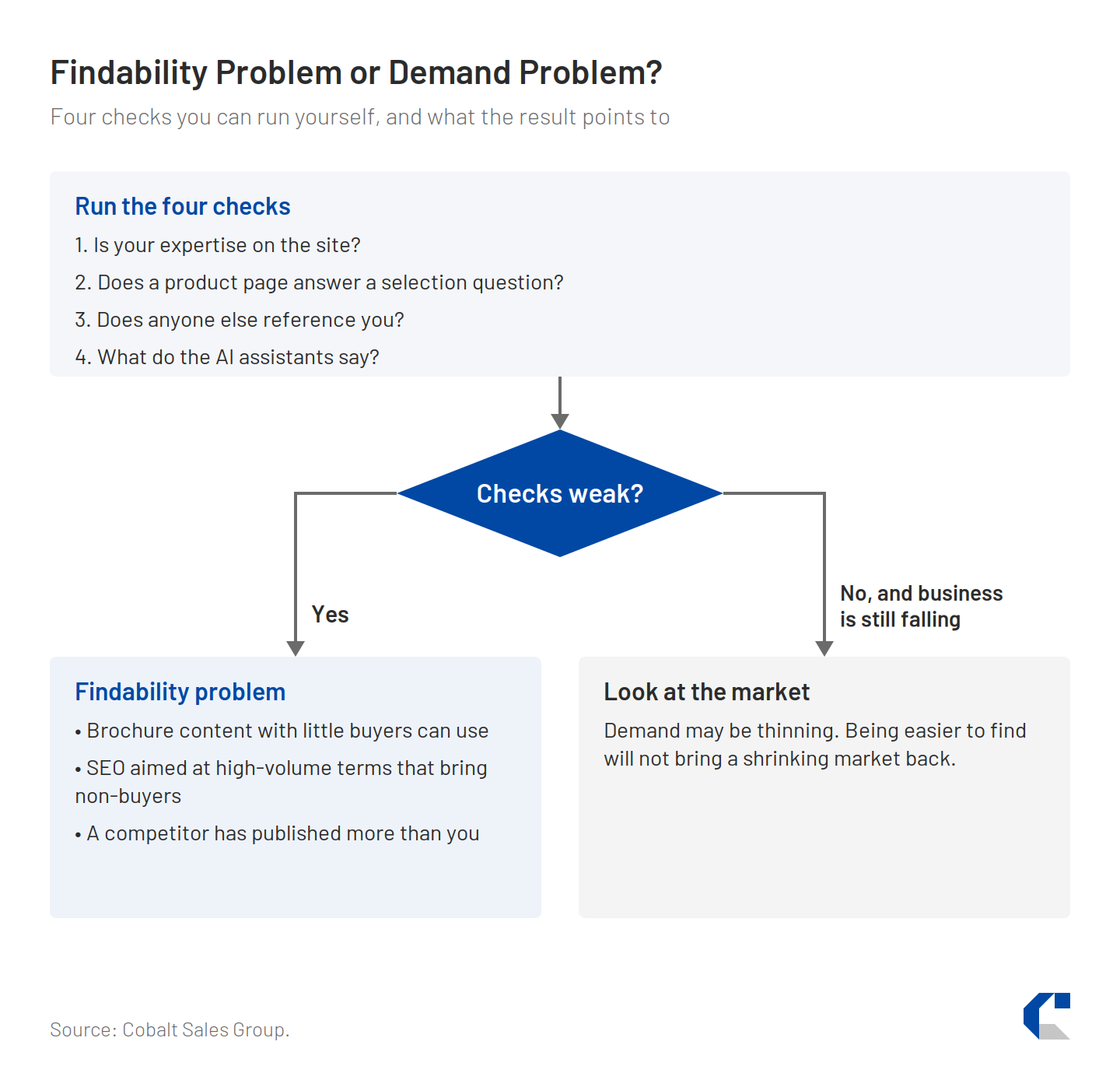
Run four checks yourself before you pay anyone to do it. Look for your technical expertise on the site, test a product page against a buyer's real selection question, see whether anyone outside the company references you, and ask the AI assistants who makes what you make.
 Source: Cobalt Sales Group.
- Is your expertise on the site? Look for anything an engineer on your staff would recognize as his own knowledge: application notes, process explanations, answers to questions customers actually ask. Expertise that exists but is hidden counts as missing. One heat exchanger manufacturer we audited had genuine engineering answers collapsed into accordion panels on a single page, its most substantial guide behind a form, and its best proof point only in a LinkedIn post, where search engines rarely surface it.
- Does a product page answer a selection question? Pick a product and ask what a buyer comparing options would need: which applications it suits, where it doesn't fit, how it compares with the alternative. If the page cannot answer that, it gives search little to work with.
- Does anyone else reference you? Trade publications, associations, directories, customers, forums. If your name appears mostly on your own site, that is an authority gap.
- What do the assistants say? Ask ChatGPT, Google's AI Mode and Perplexity who makes what you make for the applications you serve, without your company name in the question. Run each question three to five times, signed out or in an incognito window, with a fresh chat each time, and count how often you are named. A signed-in assistant can remember you and put you in the answer. As a separate check, ask each one what your company does and see whether the description is accurate.
Which buyers you need to reach changes what those checks should look for. Getting Found by the People Who Actually Buy works through it role by role.
There is one more possibility, and it deserves an honest answer. Some businesses have a demand problem rather than a findability problem. If the market for what you make is shrinking, being easier to find will not bring it back. I know this from experience: the market my own company served went away when the technology changed, and being more visible would not have saved it. If your checks come back reasonably well and business is still falling, look at the market before you look at the website. Knowing which problem you have is the first useful step.
Frequently asked questions
Why am I paying for SEO with no leads?
Usually because the work is aimed at traffic rather than at the searches buyers make. Rising traffic with no change in inquiries often points to broad terms that attract people who don't buy. Ask your provider which buyer questions you now appear for, not how many visitors you had.
What are common SEO mistakes to avoid?
Chasing high-volume terms that bring non-buyers, writing about the company instead of the buyer's problem, publishing without structure, filling pages with claims no buyer can verify, and accepting content that isn't moving you up for the searches your buyers make.
Why is my company not showing up in AI search?
Usually for the same reason it isn't ranking: there is little on the site worth citing and little outside it that mentions you. Google says its AI features need no special optimization beyond search fundamentals, so the fix is the same content work.
Find out where competitors appear and you don't
The Buyer Visibility Audit is the structured version of the checks above. It runs the category and application searches your buyers use, tests the questions they ask AI assistants, and shows where competitors appear and you don't. It scores Buyer Visibility, Authority Signals, AI Readiness and Conversion Ready. Free, one to two business days.
Editorial Note
I source from primary research where I can reach it, credible reporting of it where I can't, and leave out what I can't verify at all. Cobalt's own client figures include the measurement method and sample size.
The recommendations reflect my experience, not a settled answer. Search and buyer behavior keep changing, your situation isn't identical to my clients', and I still get things wrong. Verify anything that matters.
Find out where you stand
If you want to know what buyers and AI systems currently see when they look for a company like yours, the Buyer Visibility Audit will tell you. It is free, delivered in one to two business days, and scores four areas: Buyer Visibility, Authority Signals, AI Readiness, and Conversion Ready, including which competitors come up when buyers search the applications you serve. No obligation and no pitch attached to it. If what it shows is worth acting on, we can talk about what that would involve.
Request Your Free Buyer Visibility Audit →Free. No obligation. No pitch.