
If you suspect your company has a visibility problem, you can confirm it yourself before you spend money on it. This article gives you the method, not a teaser for one, and it is part of the larger subject covered in How Modern Manufacturers Get Found. The answer to how visible is my company online now has two parts: whether you show up when buyers search Google, and whether AI systems name you when buyers ask them questions. An owner or a capable marketing coordinator can check both with a list of buyer questions, a spreadsheet and a few free tools, then compare the results against two or three competitors.
What should a visibility audit actually cover?
A manufacturing website audit now has to cover two surfaces, not one. The first is conventional search: whether your pages come up when buyers search the terms they actually use. The second is AI answers: whether ChatGPT, Google's AI features and Perplexity name you when buyers ask questions your company should own.
Whether you call it a manufacturing website audit or an industrial website audit, the components are the same four:
- What your buyers search and ask. The questions and terms they use, in their words rather than yours.
- Where you appear. Your position in search results and in AI answers for those questions.
- What your content proves. Whether your technical knowledge is on the site in a form a buyer, a search engine or an AI system can use.
- Who gets named instead of you. The companies that show up where you don't, which are often not the competitors you would have guessed.
Auditing only the first surface leaves a blind spot. A company can hold respectable rankings for its own product names and still be absent from the AI answers buyers read before they ever click a link. The reverse happens too. You need both views to know where you stand.
How do you check what AI systems say about your company?
If you want to know how to audit website for AI search, start with a written list of ten to fifteen questions your buyers actually ask, put each one into the major AI assistants and into Google three to five times from a signed-out session, and record how often you are named and what gets said about you. That is the core of an AI visibility audit, and it costs nothing but time.
Build the question list from real conversations, not from your brochure. Ask your salespeople and whoever answers quote requests what buyers ask before they buy. A good list mixes several kinds of question: who makes a product for a particular application, how to solve a specific problem, how one process or material compares with another, and what to look for in a supplier of what you make. Leave your company name out of all of them. A buyer who already knows your name is not the one you are auditing for. Write each question down exactly as you will ask it, and reuse that wording every time you re-check.
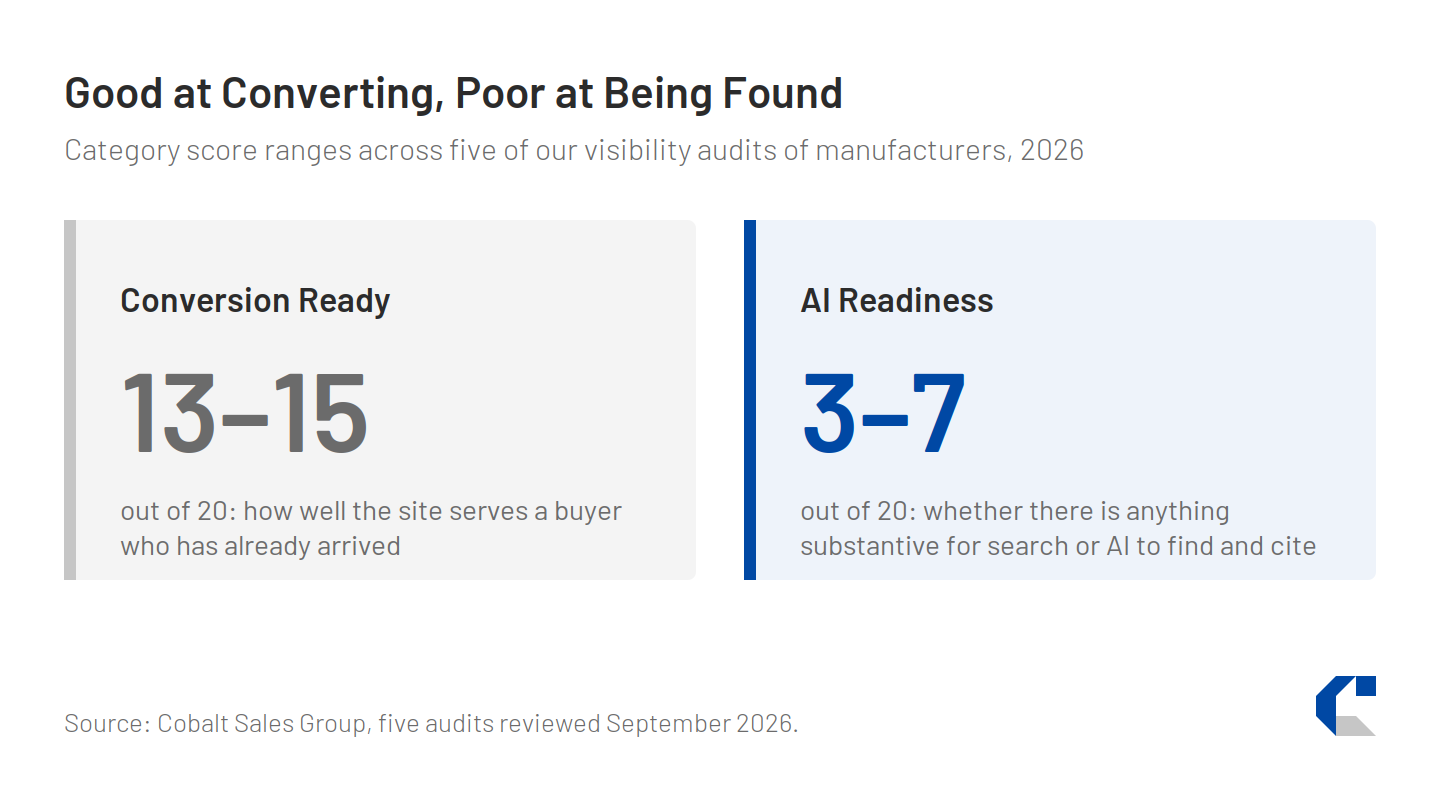
Run each question through ChatGPT, Google (noting the AI Overview when one appears, and trying AI Mode), and Perplexity, three to five times each. Use a clean session: signed out or in an incognito window, with a fresh chat for every question. A signed-in assistant can remember you and put you in the answer. Record every run in a simple spreadsheet: date, platform, question, which companies were named, whether you were named, what was said about you, and which sources were cited. A blank version of that log, with a question sheet and a quarterly scoring tab, is available to download with this article.
 Source: Cobalt Sales Group.
Presence is only the first thing to look for. Check three more:
- Accuracy. When you are named, is the description of your company right? Wrong capabilities or a wrong location are worth fixing at the source.
- Currency. Is the description current, or does it reflect a product line you dropped years ago?
- Your content. Are your own pages being cited, or only directories and third-party sites? If you have published a detailed technical guide and it doesn't appear, find out why: it may be behind a form, in a scanned PDF, or not indexed at all.
Be honest about what this check is. Answers vary between sessions, phrasings and modes. A 2026 Semrush study ran 100 prompts through ChatGPT's quick and deeper-reasoning modes and found only about a quarter of the cited domains overlapped between the two for the same prompts. That study covered software, finance, consumer tech and health rather than manufacturing, but the lesson carries: one run tells you very little. Judge by how often you are named across the runs, 0 of 5 or 3 of 5, not by any single answer. Repeat the whole list every quarter with the same wording, and treat it as an observational check rather than a metric. The pattern over time is what tells you something.
How do you audit a manufacturing website for SEO?
How to audit manufacturing website for SEO comes down to three questions: do your product and capability pages come up for the terms buyers actually use, is your technical content indexed at all, and can a search engine's crawler read the site cleanly. Most of it can be answered with free tools from Google.
Start with Google Search Console. It is free, and Google's own guidance on third-party SEO tools recommends it because its data comes directly from Google Search. The same guidance notes that third-party tools do not have access to Google's internal ranking data, and that any predictions they make are their own. Paid ranking and traffic tools are useful for direction and for looking at competitors, but their figures are estimates, not measurements.
For an SEO audit for manufacturing website purposes, three reports do most of the work:
- The queries report. Look at which searches actually bring people to your site. If nearly all of them contain your company name, buyers who don't already know you probably are not finding you.
- The page indexing report. Check whether your technical pages are in Google's index. To be eligible as a supporting link in AI Overviews or AI Mode, Google's documentation on AI features and your website says a page must be indexed and eligible to be shown with a snippet. A guide behind a form, or content that exists only in a scanned PDF, gives Google little or nothing to index.
- Crawlability. Google's same documentation lists the basics: crawling allowed in your robots.txt file and by your hosting, pages reachable through internal links, and important content available as text rather than only in images.
One useful detail from that documentation: appearances in AI Overviews and AI Mode are counted in Search Console's overall search traffic, within the "Web" search type. They are included, but not broken out separately.
Finally, look at what you are ranking for, not just how much. Broad, high-volume terms in manufacturing tend to draw students, job seekers and the curious alongside the occasional buyer. Page-one rankings for terms like that can look good in a report and do little for the business. The terms that matter are narrower: an application, a material, a problem a buyer is trying to solve.
How do you score it, and what is a good AI visibility score?
What is a good AI visibility score? There is no industry-standard one. Any tool that shows you a single AI visibility score is using its own formula, so the same company can score quite differently in two tools. What matters is the trend over time and your position against the same competitors on the same questions.
That makes scoring your own audit simpler than it sounds. Take your question list and count, for each round, how many answers named you and how many named each of your two or three competitors. Do the same for search: how many of your buyer terms put you on page one, and how many put them there. Keep the question list fixed so each quarter compares like with like. A rising count relative to competitors is the result that matters; the absolute number on its own tells you little.
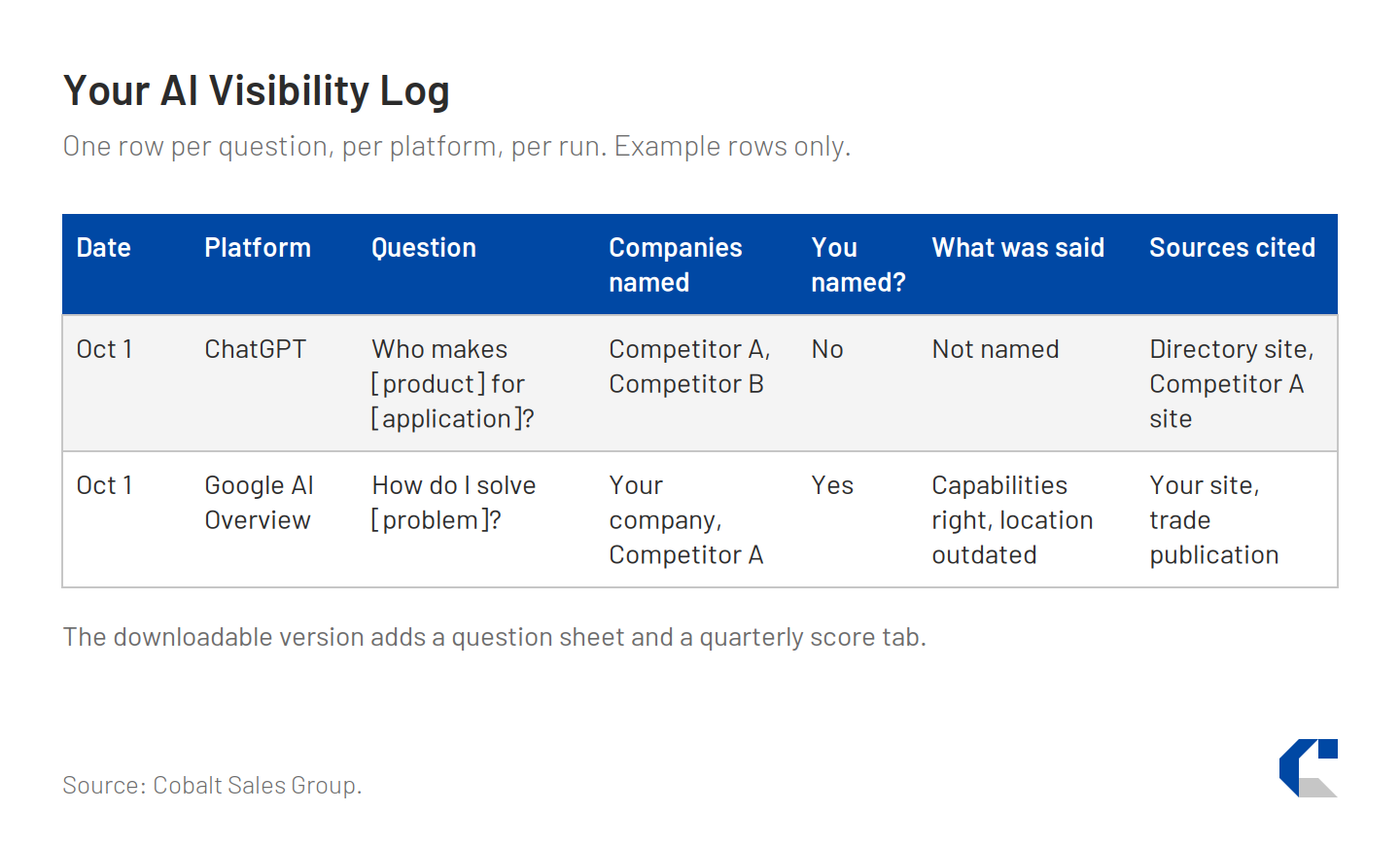
Our own audit uses one structure, as an example rather than a standard. It scores four categories out of 20 each: Buyer Visibility, Authority Signals, AI Readiness and Conversion Ready. The audit tooling does the scoring against defined criteria, and I work alongside it rather than scoring each category by hand.
The results make a useful calibration. In five recent audits, Conversion Ready scored 13 to 15 out of 20 while AI Readiness scored 3 to 7. None of the manufacturers we have audited has scored strong on authority signals. The pattern is consistent: manufacturers are generally competent at converting a buyer who arrives and poor at being found in the first place. If your own audit shows the same shape, you are in common company, and you know which half needs the work.
Source: Cobalt Sales Group, five audits reviewed September 2026.
Can you do your own SEO audit, or do you need help?
Can I do my own SEO audit? Yes. An owner or a capable marketing coordinator can run a useful first pass, and the method above is that first pass. You do not need to hire anyone to find out whether you have a problem.
What the do-it-yourself version struggles with is everything after the first pass. Keeping the same checks running consistently against competitors, quarter after quarter, is where most internal efforts fade. Knowing which questions actually carry search demand takes keyword data and time to interpret it. And judging which gaps are worth acting on, and in what order, takes some experience of what tends to move and what doesn't.
One honest observation from my side. The structured audits regularly surface things I had not thought of, and they have consistently confirmed what I see when I read a site myself. I have yet to find something in a manual read that the structured audit missed. That is a better argument for a structured audit than any claim about saving time: it is simply more thorough than one person reading a website.
Frequently asked questions
How can I check my AI visibility?
Write down ten to fifteen questions your buyers ask, without your company name in them. Put each into ChatGPT, Google and Perplexity three to five times from a signed-out session, record how often you are named and what is said about you, and repeat the same list, word for word, every quarter. The trend is what matters.
What should be included in a website audit?
Four things: what your buyers search and ask, where you appear in search results and AI answers, whether your technical content is on the site and indexed, and which companies get named instead of you.
Can I do SEO for my website myself?
Much of it, yes. The technical basics are well documented by Google, and Search Console is free. The harder part is producing substantial technical content consistently: the knowledge is already in your company, but getting it written up and published month after month is where most internal efforts stall.
Find out where competitors appear and you don't
If you would rather not run it yourself, the Buyer Visibility Audit is a structured version of this first pass. It runs the category and application searches your buyers use, tests the questions they ask AI assistants, and shows where competitors appear and you don't. It scores Buyer Visibility, Authority Signals, AI Readiness and Conversion Ready. Free, one to two business days. Either way, the useful part is knowing where you stand.
Editorial Note
I source from primary research where I can reach it, credible reporting of it where I can't, and leave out what I can't verify at all. Cobalt's own client figures include the measurement method and sample size.
The recommendations reflect my experience, not a settled answer. Search and buyer behavior keep changing, your situation isn't identical to my clients', and I still get things wrong. Verify anything that matters.
Find out where you stand
If you want to know what buyers and AI systems currently see when they look for a company like yours, the Buyer Visibility Audit will tell you. It is free, delivered in one to two business days, and scores four areas: Buyer Visibility, Authority Signals, AI Readiness, and Conversion Ready, including which competitors come up when buyers search the applications you serve. No obligation and no pitch attached to it. If what it shows is worth acting on, we can talk about what that would involve.
Request Your Free Buyer Visibility Audit →Free. No obligation. No pitch.