
If someone has told you your website lacks authority, you were probably handed an acronym, E-E-A-T, and very little else. Most of what is written about it comes from people who have never had to prove anything for a company that makes physical things. The broader argument is in Proving Technical Expertise Online, and the bigger question of How Modern Manufacturers Get Found rests on it. This piece gets specific about what each letter looks like on a manufacturer's website.
The short version: manufacturers tend to hold more genuine experience and expertise than almost any business publishing content, and show less of it than almost anyone. E-E-A-T asks a website to prove what it knows. The proof is usually concrete and already in the building: named people, your own shop floor, documented work, certifications someone can check, and other people in your industry mentioning you. None of it requires your engineers to become writers.
What is E-E-A-T in SEO?
E-E-A-T stands for Experience, Expertise, Authoritativeness and Trust. It comes from Google's Search Quality Rater Guidelines, the document Google gives the people it hires to judge the quality of its search results. The guidelines put Trust at the center of the four and treat the other three as support for it.
The raters do not rank anything themselves; the guidelines say no single rating moves a page up or down. What matters for search engine optimization (SEO) is Google's guidance for site owners, which says its ranking systems look for a mix of factors indicating E-E-A-T, with trust mattering most. E-E-A-T is not a setting you can adjust. It describes what Google is trying to reward.
The second E, Experience, was added in December 2022. The guidelines define it as first-hand or life experience with the topic. That is the part manufacturers are strongest on and worst at showing. A company that has run the same process for thirty years has more first-hand experience than any consultant writing about it, yet its website often reads as if nobody who wrote it has been inside the building. The gap lies between what the company knows and what its website can demonstrate.
How do you improve E-E-A-T on a manufacturing website?
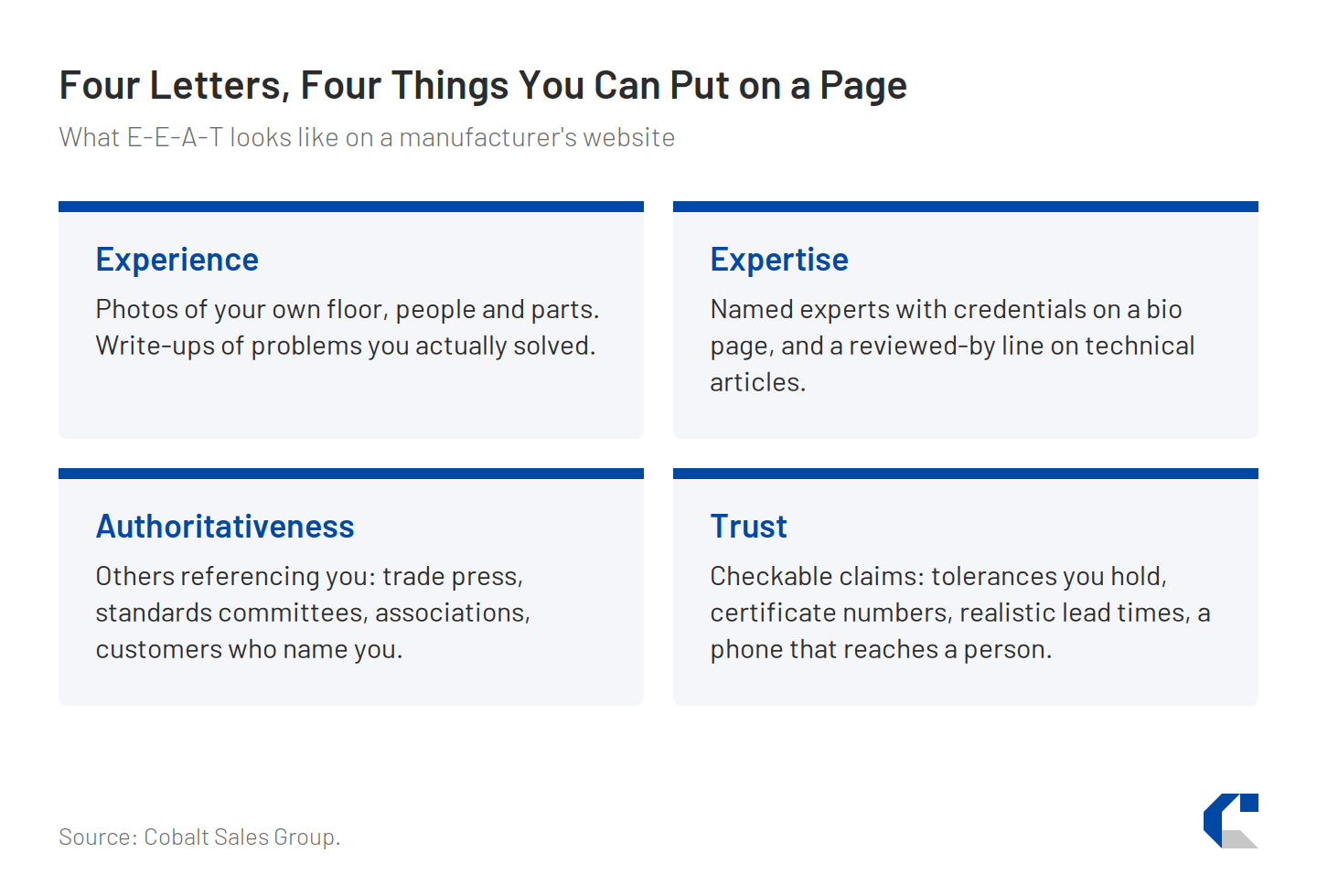
The answer to how to improve E-E-A-T for manufacturing website content is to replace assertions with evidence. Each of the four letters has a manufacturing version, and most of the material usually exists already, in a file cabinet, on a shared drive or in someone's head.
Experience: show the floor you actually run
Decades of production is the asset, and it shows through documented work rather than claims about it. Photograph your own floor, your own people and your own parts instead of using stock images of someone else's machinist. Write up problems you have actually solved: what the customer was facing, what you changed and what happened. A page like that could only have come from you, which is the point.
Expertise: put names on what your people know
Most manufacturers have someone, often an application engineer or a quality manager, who has answered the same customer question a hundred times. That knowledge is the expertise. Show it with his name and credentials: a bio page listing degrees, certifications, years in the trade and the problems he handles, plus a reviewed-by line on technical articles he has checked. He does not have to write. Someone interviews him, writes it up, and he reviews it for accuracy. The rater guidelines treat invented author profiles and inflated credentials as deceptive, so the name must belong to a real person who actually reviewed the page.
One heat exchanger manufacturer we audited publishes its technical articles under its president's byline, with an author archive collecting everything under his name. The audit flagged it as a genuine expertise signal most of its competitors lacked. It is a small thing, and it is rare.
Authoritativeness: be referenced by others
Authoritativeness means being known as a go-to source, and it cannot be self-declared. It comes from others referencing you: a trade publication quoting your engineer, a seat on a standards committee, an industry association listing, a customer who names you in his own case study. The guidelines tell raters that when a company's description of itself disagrees with independent sources, they should believe the independent sources.
Trust: make every claim checkable
Trust comes from claims someone can verify: the tolerances you actually hold, the materials you actually run, realistic lead-time ranges, certifications listed with the registrar and certificate number and kept current, and a phone number that reaches a person. Say what you do not do, too. A manufacturer that says it does not take runs under a certain quantity reads as more credible, not less.
Evidence versus assertion
The same distinction runs through all four. Stock photography, generic capability copy and unattributed blog posts are meant to look professional, but to a buyer or a rater they tend to signal a company with nothing specific to show. The guidelines tell raters to be skeptical of what websites claim about themselves where there is a conflict of interest. That is usually what I find when I audit manufacturers' websites: "highest quality" and "best in the country," which every competitor could also claim, and very little about how the company solves its customers' problems. Good E-E-A-T examples on a manufacturing site tend to look almost boring: a named engineer, a real photo, a certificate number.
 Source: Cobalt Sales Group.
How do you make Google trust a manufacturing website?
Much of the advice on how to make Google trust a manufacturing website treats trust as a feeling. In practice it means claims someone can check: credentials that belong to real people, certifications that can be verified, and details that match everywhere they appear. That includes structured data, the behind-the-scenes code that labels a page's details for search engines, which should say the same thing the visible page says.
This is where manufacturers tend to be weakest. Authority signals are one of the areas we score when we audit a manufacturer's search and AI visibility, and none of the manufacturers we have audited has scored strong on them. The bar in this industry is low. A manufacturer that does the basics well is competing against companies that mostly have not.
You can check two things yourself this week. First, search your company name while excluding your own site: in Google, type the name followed by -site:yourdomain.com. The rater guidelines tell raters to run this kind of search when researching a company's reputation. See what comes back: trade press, directories, customer mentions, or very little. Second, search the names of the two or three people who hold most of your technical knowledge alongside your company's. If they appear nowhere, a buyer or a rater has no way to know they exist.
Why do the same signals matter to AI systems?
For Google's own AI answers, the connection is documented rather than guessed. Google says its generative AI features in Search are rooted in its core Search ranking and quality systems, so the work that earns trust in conventional search is the same work that earns a place in Google's AI answers. For other assistants, nobody outside those companies can say exactly how sources are chosen.
My working belief is that clear authorship, specific detail and depth serve both a human rater and an AI system deciding whether a page is worth naming, because they make a page easier to verify and to quote accurately. That is a belief, not a measured result, and I will not tell you which factor counts most, because I do not know. What I am confident about is the downside, which is close to zero: a named engineer, a real photograph and a checkable certificate cost little and make the site more credible to the buyer reading it, whatever any system does with them.
Frequently asked questions
How can a manufacturing website effectively show real factory experience and expertise to Google?
Publish what only you could publish: photographs of your own floor and people, write-ups of real jobs, and named experts with their credentials. Google cannot walk your plant, so the page has to carry the evidence.
How can a manufacturing business demonstrate E-E-A-T effectively to improve its search authority?
Replace claims with evidence under each of the four letters, then work on what others say about you in trade press, associations and standards bodies. Treat it as making the site credible rather than as a ranking trick; E-E-A-T is not a single factor anyone can switch on.
What are some practical ways to highlight the expertise of engineers and staff on a company’s website?
Give each expert a bio page with credentials and years in the trade, put a reviewed-by line with his name on content he has checked, and quote him by name in application notes. None of it requires him to write; an interview and a review of the draft are enough.
Find out how your authority signals score
The Buyer Visibility Audit scores Authority Signals, the area none of the manufacturers we have audited has scored strong on, alongside Buyer Visibility, AI Readiness and Conversion Ready. Free, one to two business days.
Editorial Note
I source from primary research where I can reach it, credible reporting of it where I can't, and leave out what I can't verify at all. Cobalt's own client figures include the measurement method and sample size.
The recommendations reflect my experience, not a settled answer. Search and buyer behavior keep changing, your situation isn't identical to my clients', and I still get things wrong. Verify anything that matters.
Find out where you stand
If you want to know what buyers and AI systems currently see when they look for a company like yours, the Buyer Visibility Audit will tell you. It is free, delivered in one to two business days, and scores four areas: Buyer Visibility, Authority Signals, AI Readiness, and Conversion Ready, including which competitors come up when buyers search the applications you serve. No obligation and no pitch attached to it. If what it shows is worth acting on, we can talk about what that would involve.
Request Your Free Buyer Visibility Audit →Free. No obligation. No pitch.