
You have a website. It looks respectable, the photos are decent, and it has been sitting there for years costing you almost nothing and producing about the same. Or worse: it used to produce, and lately the phone is quieter than it should be.
Either way, something is wrong, and the fixes people sell you tend to assume they already know what. This article is the diagnostic that should come first. The build side of the question is covered in How to Build a Manufacturing Website That Generates Leads, and the full subject in Manufacturing Lead Generation.
The most common reason is that the site was built as a brochure — history, capabilities summary, contact page — which describes you to someone who already found you and does nothing to get you found. GlobalSpec's 2026 survey found that 62% of the buying journey happens online before a buyer contacts anyone, so a site that is not part of that research is not losing the comparison; it was never in it. If the site used to produce and has gone quiet, the cause is usually the market, a competitor who stepped up online, or referral sources aging out. Each leaves different evidence, so work out which one you have before spending anything on a fix.
Why is my manufacturing website not generating leads?
The most common reason a manufacturing website generates no leads is that it was built as a brochure: a company history, a capabilities summary, and a contact page. A brochure describes you to someone who already found you. It does nothing to get you found, and it rarely answers the questions a buyer is actually researching. The site is not broken. It was never built to do this job.
I see this constantly, and it is usually nobody’s fault. The site was built years ago to exist, not to work. ACT Sensors, a client of ours, is a fair picture of the starting point: a basic brochure-style site that rarely changed, with a product catalog that was technically on there but not findable or searchable. Nothing about it was wrong as a brochure. As a lead generation asset it had almost nothing to work with.
Here is why that matters more than it used to. The 2026 State of Marketing to Engineers survey from GlobalSpec and TREW Marketing, which surveyed over 1,000 engineers and technical buyers, found that 62% of the buying journey now happens online before a buyer ever contacts a vendor. Most of the evaluation is over before your sales team knows the buyer exists. If your site is not part of that research, you are not losing the comparison. You were never in it.
The second pattern sits on sites that do publish. The content is about the company and the product, when the buyer is researching a problem. That is the difference between content an engineer skims past and content an engineer actually uses, and it is why a site can post regularly for years and produce nothing. Buyers are looking for online content to educate themselves. Give them nothing to learn from and they learn from your competitor.
Why did our RFQs slow down?
When RFQs slow down, the cause is usually one of three things: the market slowed, a competitor stepped up their online game, or the referral sources that quietly fed you are drying up. Each one leaves different evidence, so before spending anything on a fix, work out which problem you actually have.
The market case is the easiest to check. Talk to your peers, your suppliers, your trade association. If everyone in your niche is slow, your website was never the problem. That is not a reason to go quiet, though. A soft market means fewer buyers, not zero, and every one of them still researches before they buy. The companies that stay visible are fighting for what demand remains; the companies that pull back are conceding it. Marketing will not fix a soft market, but it decides who gets the work that is still out there.
The smarter move is to invest when business is good, because that is when you have the money. Owners tell me the opposite all the time: “I don’t need marketing right now, I’m busy.” What they are picturing is advertising, which you switch on when you need work and switch off when you don’t. Educational content is a different kind of investment. It takes time to build, and then it lasts, working for you long after the spend. The owner who waits for the slowdown ends up needing authority he no longer has money to build. That is the catch-22, and the only way out of it is to start before you need it.
The competitor case is almost as easy to check and much less comfortable. Search the questions your buyers ask, in Google and in an AI tool, and see who shows up. If you would rather have someone run that check for you, that is what the Buyer Visibility Audit is. If a competitor has spent two years building out real answers while your site stayed still, they are now in the research that happens before anyone calls. And familiarity compounds: GlobalSpec found that 70% of technical buyers are likely or very likely to choose the better-known brand when two solutions are technically similar. A competitor who became visible did not just win the buyers who found them. They became the safer-feeling choice for everyone who found both of you.
The third cause is easy to miss precisely because referrals are a silent source. Nobody logs them, nobody reports on them, and while they flow you never have to think about where they come from. If most of your inquiries have always come through referrals, your pipeline depends on specific people: the engineer who always recommended you, the purchasing manager who knew your work, the rep who sent things your way. Those people retire, change jobs, and get acquired out of their roles. Nothing dramatic happens. The stream just thins, year after year, and the website that never had to generate leads is suddenly the only channel left standing, and it was built as a brochure.
Go back through your last two or three years of inquiries and mark where each one actually came from. If the honest answer is mostly names rather than channels, the slowdown has little to do with demand and a lot to do with a referral network aging out from under you.
Why is my company not showing up on Google?
Not showing up on Google is usually an authority problem, not a technical one. Technical faults are real but rare: a site that blocks crawlers or takes ten seconds to load has a mechanical problem worth fixing. For most manufacturers, though, the site is indexed and functioning. It just gives Google no reason to surface it, because it says almost nothing about the subjects buyers search.
Google and the AI systems built on top of it are trying to answer a question with the most credible source available. A brochure site is not a credible source on anything except its own existence. The company that has covered the subject, the questions, the trade-offs, the failure modes, the specifications, gets treated as the authority. Most manufacturers don’t have an expertise problem. They have a visibility problem: the knowledge is in the building and nowhere on the site.
The objection I hear most is some version of “we’re too niche, nobody is searching for what we do.” Almost every company believes it is the exception, and most are wrong in a useful direction. We’re not looking for volume. It’s great to be a niche company and dominate that niche. For most of my clients, two or three good new customers a year justifies the entire effort, and a narrow specialty is easier to own, not harder.
The other thing owners assume is that the territory is already taken. The data says otherwise. A 2026 Semrush study of ChatGPT answers across 50,000 brands and 1,094 US categories found that only 15.2% of categories have a clear brand owner, and 53.7% are unsettled, with no leader at all. In most categories, including industrial ones, the position of “the company AI systems cite” is sitting there unclaimed.
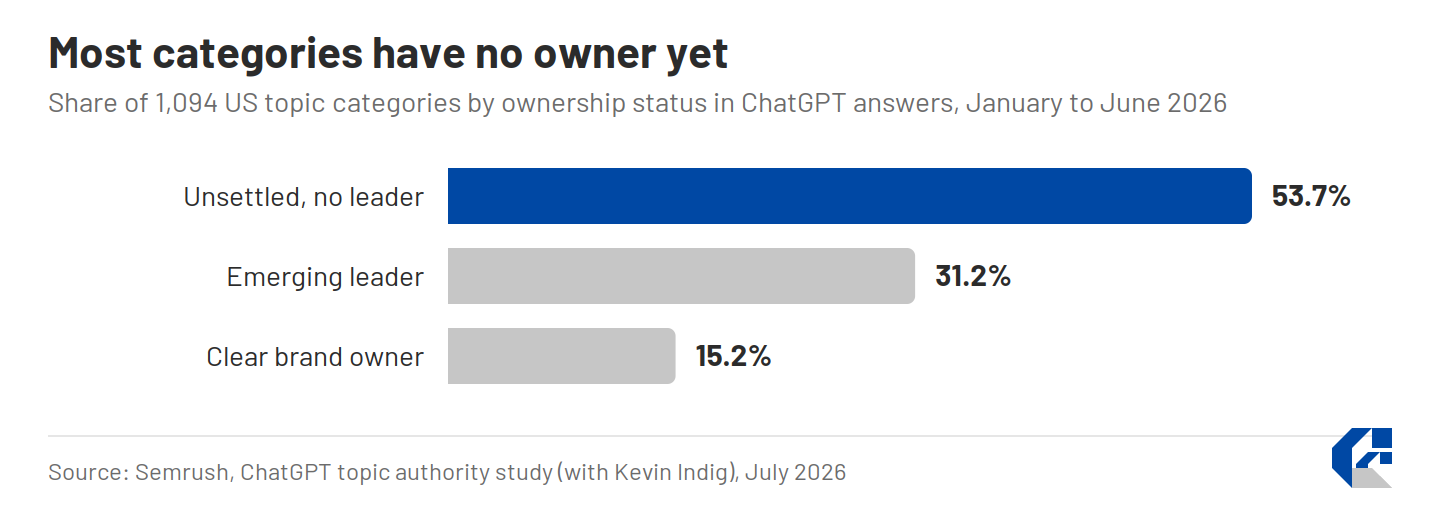 Source: Semrush, ChatGPT topic authority study (with Kevin Indig), July 2026.
Claimed, it looks like this: ACT Sensors, the same company that started with the brochure site, now gets cited by Google’s AI Overviews in 333 of 1,122 tracked queries about liquid level sensors, a rate of 29.7%. Gems Sensors, a far more established name in that category, sits at 5.8%. The niche was small. That is precisely why it was winnable.
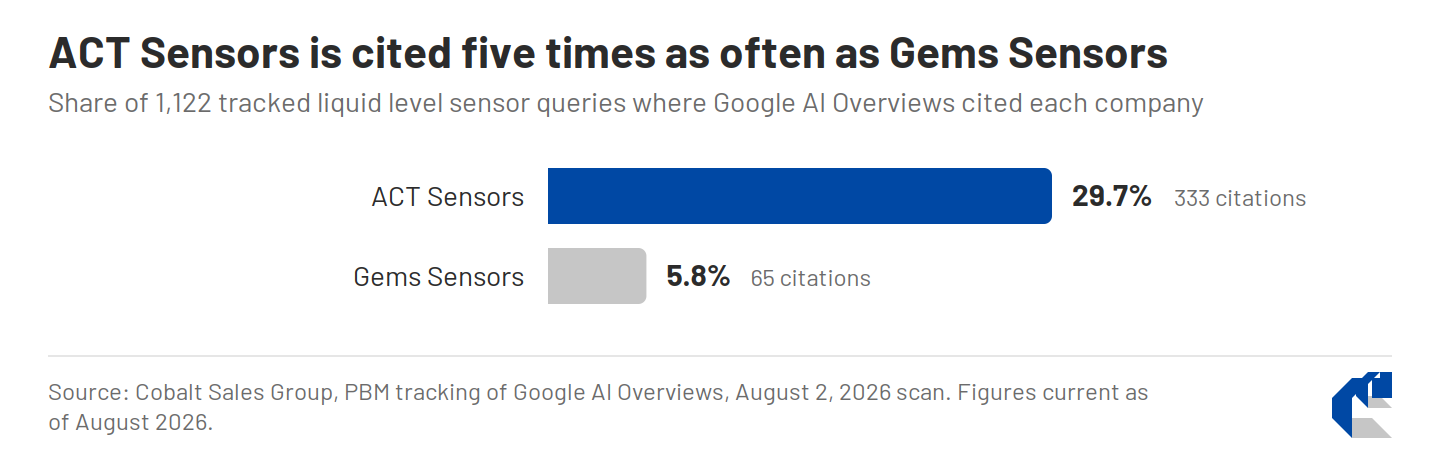 Source: Cobalt Sales Group, PBM tracking of Google AI Overviews, August 2, 2026 scan.
What is the best way to measure ROI?
Measure ROI with the numbers you can actually see: is qualified inquiry volume trending up, and what is a new customer worth against what you spent to become visible? You own both ends of that math. You know what came in through your forms, your inbox, and your phone, and you know better than anyone what a customer is worth over the life of the relationship.
Watch three things. First, traffic to the pages that answer buyer questions; if that trend is rising now, at a time when website traffic is broadly declining, something real is happening. Second, inquiries themselves: form submissions, emails, calls, with a note on where each came from. Third, quality. Ten inquiries from buyers who already understand what you do beat a hundred from people who never should have called.
What I would not do is measure yourself against the average cost per lead for B2B. Owners reach for that benchmark because it feels like an objective yardstick, and it is not one. Published figures disagree with each other by an order of magnitude, because each one measures a different funnel stage with different costs included, and a manufacturer selling million-dollar systems has no business on the same chart as an ecommerce store anyway. Compare the cost of being visible with the lifetime value of the customers it brings you, not with an average that was never about your business.
Where that leaves you
The diagnostic order matters: rule out the market, check who owns the searches your buyers make, and audit where your inquiries have really been coming from. Most of the time the finding is the same one. The expertise that wins you work face to face was never put where buyers, and now AI systems, could find it.
The question worth asking is not whether the website looks dated. It is whether a buyer researching your specialty this week would come away knowing your company belongs on the list.
Frequently asked questions
Why are we not getting RFQs from our website?
Split the problem in two. If almost nobody visits, the issue is visibility: your site does not appear where buyers research, so no RFQ was ever possible. If you have traffic and still no RFQs, the issue is on the page: buyers arrive, find nothing that qualifies you for their work, and leave without a trace. Check your analytics first to see which problem you have, because the fixes are completely different and agencies routinely sell the wrong one.
Why do most business websites fail to generate leads?
Most business websites fail to generate leads because they were built to describe the company rather than to answer what buyers search. The typical site covers history, values, and a capabilities list, none of which matches a real query from a real buyer with a real problem. No match, no visibility; no visibility, no leads. The sites that produce are structured around the buyer’s questions, with the company’s expertise as the evidence rather than the subject.
How do I get more RFQs for my machine shop?
The same diagnosis applies to a machine shop, with one sharpening: your buyers search in specifics. Materials, tolerances, processes, part types. A shop site that answers those questions, shows real work, and makes the quote request obvious will out-produce a general capabilities page every time. Response speed matters too, since the buyer who sends an RFQ has usually sent three. Marketing a shop more broadly is its own subject, and I cover it in How to Market a Machine Shop (and Other Specialty Manufacturers).
Editorial Note
I source from primary research where I can reach it, credible reporting of it where I can’t, and leave out what I can’t verify at all. Cobalt’s own client figures include the measurement method and sample size.
The recommendations reflect my experience, not a settled answer. Search and buyer behavior keep changing, your situation isn’t identical to my clients’, and I still get things wrong. Verify anything that matters.
Ready to stop reading and find out where you stand?
Everything in the Learning Center explains the problem. The Buyer Visibility Audit™ tells you where your company sits right now — in Google, in AI answers, and against the competitors your buyers are comparing you to.
Request Your Free Buyer Visibility Audit →Free. No sales pitch. Delivered within 1–2 business days.