
Every manufacturer I talk to asks about cost before anything else, and most of them have already tried to answer it on their own. They searched, found a number, then found a second number five times higher, and closed the laptop knowing less than when they started. I understand the impulse completely. I ran a manufacturing company for 23 years, and I wanted a ballpark before I let any vendor book a meeting.
So this article is the ballpark, written by someone who sells the service. Read it with the same skepticism you would bring to any vendor's pricing page. For the full picture of how this discipline works, see Manufacturing Lead Generation.
Here is the short version. There is no reliable cost-per-lead benchmark for manufacturing. The published numbers disagree with each other by an order of magnitude because they count different things, and anyone who quotes you one is repeating a figure they cannot trace. What you can pin down is a program's total monthly investment, and I will tell you below exactly what Cobalt's costs and what that buys. Whether it is expensive depends on two numbers only you can supply: what a new customer is worth to your business over the life of the relationship, and what it costs you to stay invisible while your buyers do most of their research online.
How much does manufacturing lead generation cost?
There is no standard industry price and no trustworthy cost-per-lead figure for manufacturers. The number you can actually compare across providers is total monthly investment. Cobalt's Authority Growth Program, to use the example I know best, runs $3,500 a month.
You want a straight number before you talk to anyone, and I don't blame you. Your own buyers behave the same way toward you. McKinsey's 2026 Global B2B Pulse Survey found that 52% of buyers would stop working with a supplier whose teams give inconsistent information about price, availability, or lead time. It was the top switching driver in the survey. Vagueness about money costs suppliers business, so I will be as direct as this subject allows.
Here is what that monthly fee covers at Cobalt: research into what your buyers actually search for and ask, articles written to answer those questions and reviewed by your technical people, a steady publishing schedule, and measurement of the three things we can honestly measure, which are AI citation rate in Google AI Overviews, search rankings, and organic traffic. Here is where it stops: our work ends at the inquiry. Answering the phone, quoting, and following up stay with you, because we are not inside your business and will not pretend to be.
That is one firm's program, priced as a monthly retainer rather than per lead. If you are weighing those two models against each other, Pay Per Lead vs Monthly Retainer: What Works for Manufacturers walks through what each one buys.
What should you expect to drive the price of any serious program? Three things. The length of your sales cycle, because a buyer who takes a year to decide needs to keep finding you for a year. The technical depth of your subject, because content an engineer will trust takes real work to produce and review. And your own standard for a lead worth having, because reaching a handful of the right buyers takes more precision than reaching a crowd of the wrong ones.
Now the part most articles on this subject won't say. I cannot give you a cost per lead. When owners ask me directly what a realistic cost-per-lead range is for a manufacturer running an inbound program, my honest answer is:
I can't answer that. I have no idea.
Cobalt measures visibility. We do not see into our clients' phone systems, inboxes, or CRMs, so we cannot count their leads, and any cost-per-lead figure I handed you would be invented. I would rather tell you that than make one up, because as you are about to see, everyone else's numbers have exactly that problem.
What is a good cost per lead for industrial companies?
Nobody can tell you, and you should be suspicious of anyone who tries. No published cost-per-lead benchmark measures manufacturing with a stated methodology, and the figures in circulation disagree with each other by an order of magnitude. A number that unstable is not a benchmark.
Average cost per lead for b2b is one of the most-searched money questions in this field, and the search results are a mess. One source counts advertising spend against raw form fills. Another loads in agency fees, salaries, and software, and counts only the leads a salesperson accepted. A third measures a single channel at a single funnel stage. None of them states how many manufacturers, if any, sat in the sample. They are not measuring the same thing, so of course they disagree, and averaging figures that disagree by ten times does not produce a benchmark.
The same problem sinks the comparison people ask me for most often: how manufacturing stacks up against software or professional services. When a software company says lead, it often means a free trial signup that costs nothing to fulfill. When you say lead, you may mean an engineer with a print and a deadline asking you to quote. The word is the same. The transaction is not. Any table that puts those in adjacent rows is comparing things that do not convert into each other, which is why I won't reproduce one here. That is not a claim that manufacturing leads cost more. It is a claim that the comparison itself does not work.
What you can do without a benchmark is make whatever you spend go further. Two habits matter most. First, spend against demand you can verify: write for the questions buyers are provably asking instead of guessing at topics, so none of your budget goes to answering questions nobody has. Second, decide what a lead worth having looks like before you spend a dollar. Most of my clients do not need volume. A small number of right-fit new customers a year justifies the whole program, and defining that up front keeps you from paying to attract inquiries you would never quote. Chasing a lower cost per lead usually produces more leads and worse ones, which lowers the number on the report while raising your real cost per customer.
If you would rather talk through your own numbers than read more about everyone else's, reach out. That conversation costs nothing.
How much is a qualified lead worth?
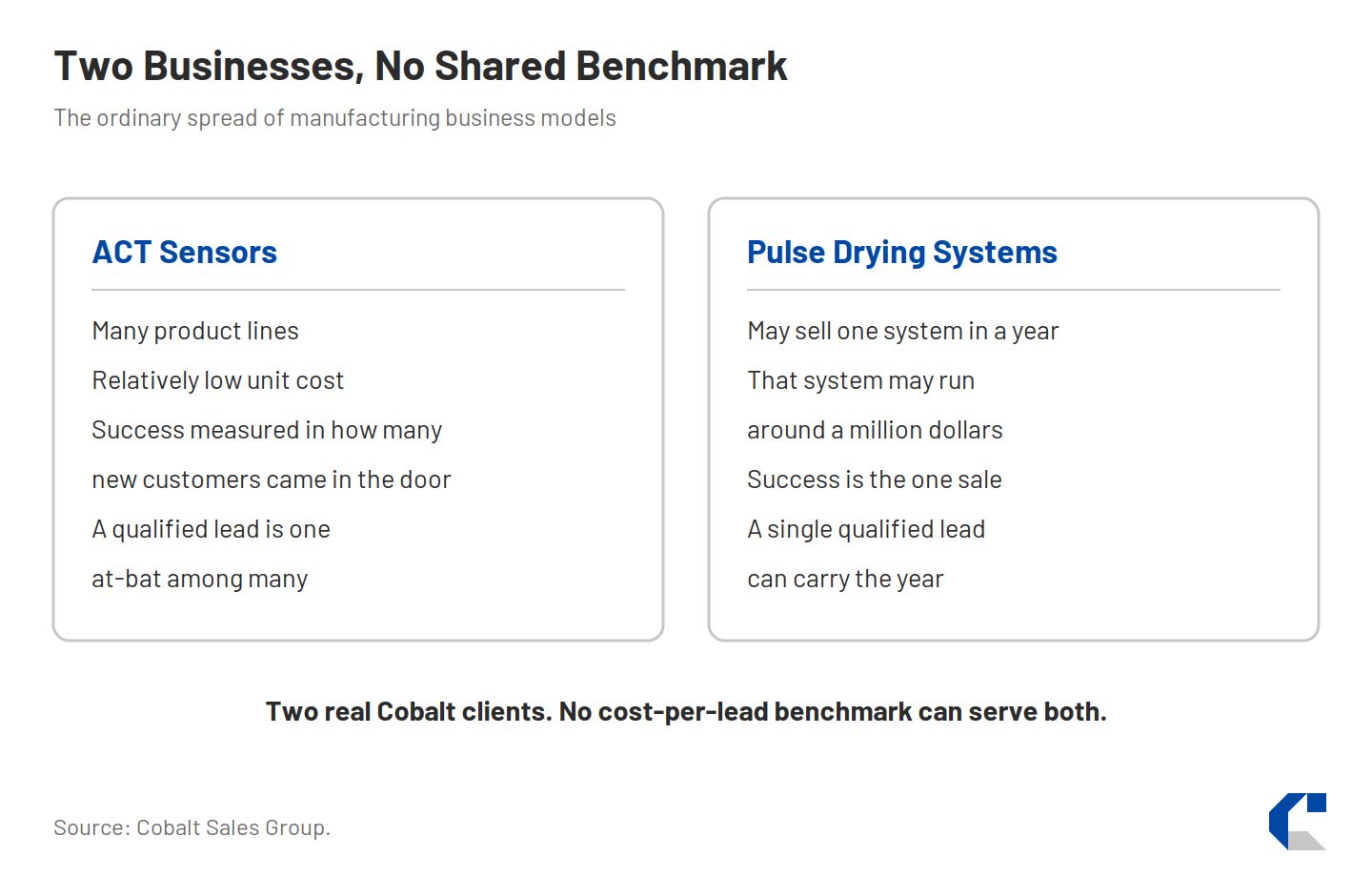
That depends entirely on what you sell and how you sell it, which is the real reason no benchmark can serve every manufacturer. Two of my clients make the point better than any industry figure could.
ACT Sensors sells sensors at relatively low cost across many product lines. A good year there is measured in how many new customers came in the door, because each account starts small and can grow for years. Pulse Drying Systems is the opposite case. They might sell one system in a year, and that one system might be a million dollars. For ACT, a qualified lead is one at-bat among many. For Pulse, a single qualified lead can carry the year.
Hold those two companies to the same cost-per-lead target and the target is meaningless for both. A per-lead cost that would sink ACT's economics would be a rounding error against a Pulse system. And this is not an exotic edge case. It is the ordinary spread of manufacturing business models, which is why I tell owners to stop hunting for the industry number and do their own arithmetic instead. What is a new customer worth to you over the life of the relationship? You know your deal sizes, your margins, and how long a good customer stays. That number is knowable, it is yours, and it is the denominator every spending decision should sit on.
 Source Cobalt Sales Group .
Then there is the second question, the one I ask back when an owner presses me on cost per lead. Do you believe your buyers are using the internet to search for and vet vendors? GlobalSpec's 2026 survey of engineers found that 62% of the buying journey happens online before a vendor is ever contacted. If you believe that, the question becomes:
Do you want to be found during that stretch, or do you want to be ignored?
Being ignored has a cost too. It never shows up on an invoice, and it is the most expensive line item in this whole subject, because the buyers who ruled you out never told you they existed.
The Cost Question Only You Can Answer
The industry cannot hand you a benchmark, and that is a finding, not a dodge. What it can hand you is a total monthly investment to weigh against your own numbers. Three of them, specifically: what one new customer is worth over the relationship, how long your sales cycle takes to turn a found buyer into a sold one (visibility measures move within months; new customers arrive on your cycle, which may be a year or more), and what staying invisible is quietly costing you while most of the buying journey happens where you cannot see it.
The question worth asking is not what a lead costs in your industry. Nobody can tell you that, and I have shown you why. The question is what it costs your company, specifically, to be ignored while your buyers do their research online. That one you can answer, and it is the honest place to start.
Frequently Asked Questions
What is a normal cost per lead?
There is no normal, because the published figures do not measure the same thing. What counts as a lead, which costs go into the math, and which stage of the funnel gets measured all vary from source to source, and the results differ by an order of magnitude. What is normal for your company is set by your industry, your buyer, and your own standard for a lead worth quoting, and it becomes visible only in your own records over time.
How much do B2B leads cost?
Published answers disagree so widely that the question cannot be answered as asked. Each source defines leads and costs differently, and none states a manufacturing-specific methodology, so the figures range across an order of magnitude. The more useful version of the question runs the other way: what is a lead worth to your business? For a manufacturer whose average customer is worth five or six figures over the relationship, the cost of any one lead matters far less than the cost of never being found by that buyer at all.
Editorial Note
I source from primary research where I can reach it, credible reporting of it where I can't, and leave out what I can't verify at all. Cobalt's own client figures include the measurement method and sample size.
The recommendations reflect my experience, not a settled answer. Search and buyer behavior keep changing, your situation isn't identical to my clients', and I still get things wrong. Verify anything that matters.
Want to talk actual numbers, yours? If you want to walk through what a program would cost for your company and whether it makes sense against what a new customer is worth to you, reach out. I will tell you what I know, what I don't, and whether this approach fits your business at all. No promises. Just a straight conversation with someone who spent 23 years on your side of the desk.
Want to talk actual numbers, yours? If you want to walk through what a program would cost for your company and whether it makes sense against what a new customer is worth to you, reach out. I will tell you what I know, what I don't, and whether this approach fits your business at all. No promises. Just a straight conversation with someone who spent 23 years on your side of the desk.
Book a Discovery Meeting